Monotropic Thinking
Jump to a section
I love learning new words, and this is one I learnt this week from an autistic client of mine – monotropism – which is based on the idea that the mind functions as an interest-based system.
Autistic individuals often exhibit deep and sustained focus on a narrow range of interests, compared to allistic individuals (non-autistic people).
So, autistic individuals can be incredibly good at narrowing down their focus and filtering out any irrelevant stimuli. This makes it difficult to shift focus or respond to things outside their attention tunnel – gamers who don't talk, eat, or drink for several hours at a time? Hello....
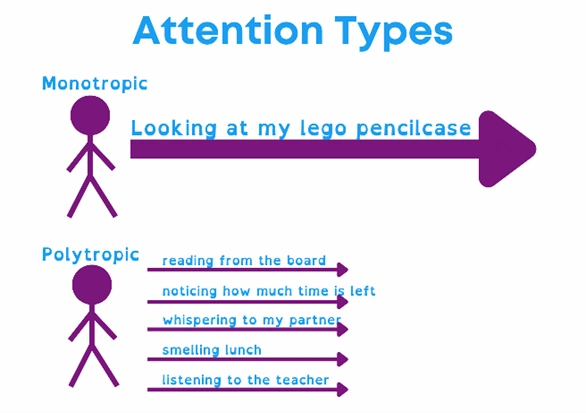
- Monotropic: Focuses on a small number of interests at a time, prioritising depth over breadth.
- Polytropic: Spreads attention fluidly across multiple surface-level streams simultaneously. Most neurotypical brains operate in this manner.
- Attention Tunnels: When a monotropic brain engages with a task, attention pulls into a deep "tunnel." The mind filters out competing background stimuli to focus intensely.
- The "Flow" State: This intense focus frequently triggers hyper-focus, enabling deep analysis, pattern recognition, and specialised skill-building.
- Task-Switching Exhaustion: Moving between attention tunnels requires significant mental effort. Interruptions can feel physically jarring, and changing tasks is mentally exhausting.
How does this relate to difficulties in day-to-day life?
Sometimes people who are autistic will enter a state of deep focus and become so engrossed in a task that they forget to do anything else – including basic needs like showering and eating. This can then cause mood disturbances because their body has been deprived of its basic needs.
This can also be difficult because, once in this state of flow, if someone like a partner disturbs them, they can become quite irritated and aggressive due to the difficulty of moving in and out of this state.
This also relates to the black-and-white thinking that can be prevalent in those on the autism spectrum – it's either all or nothing, yes or no.
And when it comes to starting and finishing tasks in our everyday lives, this doesn't always go according to plan.
So – how do we provide neuroaffirming therapy, and helpful tools for people who have monotropic thinking and significant periods of intense focus?
- We find ways to harness this behaviour and have it support their lifestyle. For example, finding ways to move in and out of this state in a calmer and safer way – potentially planning around it better, educating those around us about what we need when entering and exiting a state of focus – and setting up practical tools like visual reminders to eat and drink water.
I've also seen this occur with people who have ADHD – again and again, we see many similarities between ADHD and autism. The amount of overlap is substantial – it makes me wonder if, in 10 years' time, both diagnoses will be combined under a new name.
Anyway – watch this space! Who knows what the future holds. The mental health field is ever-evolving.
If this style of thinking and focus sounds like you, and you'd love some help managing it better, please book a call or go straight to scheduling a meeting – I'd be more than happy to help.